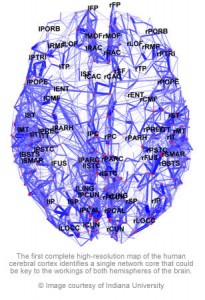
 Through the power of Google Earth, you can travel the globe from the comfort of your computer screen, peering down on everything from above. But once you change your perspective – if you go into one of the buildings that you’ve looked down on – you have to upload a new map. Now, researchers at the Norwegian University of Science and Technology (NTNU) have discovered that the brain also creates multiple independent maps while finding the way in the physical world. [continue reading…]
Brain
Information designer Tom Wujec talks through three areas of the brain that help us understand words, images, feelings, connections. In this short talk from TEDU, he asks: How can we best engage our brains to help us better understand big ideas?
Source: TED

Image: Getty images
Ask middle-school students if they are popular or make friends easily, they likely will depend on social comparisons with their peers for an answer. Such reliance on the perceived opinions of others, or reflected self-appraisals, has long been assumed, but new evidence supporting this claim has now been found in the teen brain.
Using functional magnetic resonance imaging (fMRI), researchers looked at adolescent and young-adult brain activity related to both direct self-appraisals, such as “Do I think I’m smart?” and perceptions of others’ opinions — reflected self-appraisals: “Do I think my friend thinks I’m lonely?”
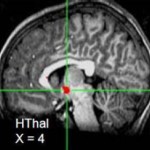
Hypothalamus, a node of the emotion circuit. (Credit: Image courtesy of NIH/National Institute of Mental Health)
During direct self-appraisals, researchers found that adolescents show more activity than adults in neural networks tied to self-perception (medial prefrontal and parietal cortices) and in areas linked to social cognition (dorsomedial prefrontal cortex, temporal-parietal junction and posterior superior temporal sulcus). The results, said lead author Jennifer H. Pfeifer, a psychology professor at the University of Oregon, suggest that adolescent self-perceptions depend heavily on others. [continue reading…]
Information designer Tom Wujec talks through three areas of the brain that help us understand words, images, feelings, connections. In this short talk from TEDU, he asks: How can we best engage our brains to help us better understand big ideas?
Source:Ted