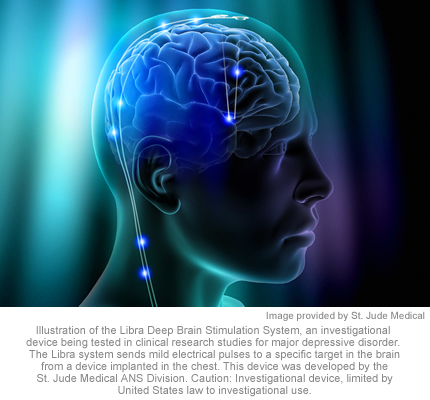
 The study, called BROADEN™ (BROdmann Area 25 DEep brain Neuromodulation), is a controlled, multi-site, blinded study that is evaluating the safety and effectiveness of DBS in patients with depression for whom currently available treatments are not effective.
“We are excited to be part of the first double-blind study of Deep Brain Stimulation for depression and remain hopeful that this therapy may prove beneficial for this seriously ill patient population,” said Anthony D’Agostino, M.D., medical director of Alexian Brothers Behavioral Health Hospital and the principal investigator at the study site. “The study is an important contribution to the advancement of treatment options for severely depressed patients.”
This study is researching a specific area in the brain called Brodmann Area 25 that is thought to be involved in depression. The first research of DBS for depression was conducted in Toronto, Canada, by neurologist Helen S. Mayberg, M.D., and neurosurgeon Andres Lozano, M.D., in 2003. They published their findings in Neuron in March 2005, reporting that brain imaging studies indicate that Brodmann Area 25 appears to be overactive in profoundly sad and depressed people. [continue reading…]
Stimulant medications such as Ritalin have been prescribed for decades to treat attention deficit hyperactivity disorder (ADHD), and their popularity as “cognition enhancers” has recently surged among the healthy, as well.
What’s now starting to catch up is knowledge of what these drugs actually do in the brain. In a paper publishing online this week in Biological Psychiatry, University of Wisconsin-Madison psychology researchers David Devilbiss and Craig Berridge report that Ritalin fine-tunes the functioning of neurons in the prefrontal cortex (PFC) — a brain region involved in attention, decision-making and impulse control — while having few effects outside it. [continue reading…]
You went to a wedding yesterday. The service was beautiful, the food and drink flowed and there was dancing all night. But people tell you that you are in hospital, that you have been in hospital for weeks, and that you didn’t go to a wedding yesterday at all.
The experience of false memories like this following neurological damage is known as confabulation. The reasons why patients experience false memories such as these has largely remained a mystery. Now a new study conducted by Dr Martha Turner and colleagues at University College London, published in the May 2008 issue of Cortex offers some clues as to what might be going on.
The authors studied 50 patients who had damage to different parts of the brain, and found that those who confabulated all shared damage to the inferior medial prefrontal cortex, a region in the centre of the front part of the brain just behind the eyes.
“The patients who confabulated had varying levels of memory ability, and varying levels of “executive functioning” (the set of cognitive abilities overseen by the prefrontal cortex that control and regulate other abilities and behaviours), so confabulation cannot be as simple as a combination of these deficits. Instead it must be due to a specific function controlled by the inferior medial prefrontal cortex. Damage to this region appears to lead to the convincing experience of false memories” says Martha Turner, corresponding author for this study.
This study has implications for our understanding of how the human brain controls memory, and how most of us are able to easily tell apart true memories from things we have imagined, dreamed or invented.
Source: AlphaGallileo. The article “Confabulation: Damage to a specific inferior medial prefrontal system” by Martha S. Turner, Lisa Cipolotti, Tarek A. Yousry and Tim Shallice, and it appears in Cortex, Volume 44, Issue 6 (May 2008), pp 637-648, published by Elsevier Masson, in Italy. Full text of the article featured above is available upon request. v.brancolini@elsevier.com to obtain a copy.
The New York Times
By SARA REISTAD-LONG
Published: May 20, 2008
When older people can no longer remember names at a cocktail party, they tend to think that their brainpower is declining. But a growing number of studies suggest that this assumption is often wrong.
Instead, the research finds, the aging brain is simply taking in more data and trying to sift through a clutter of information, often to its long-term benefit.
The studies are analyzed in a new edition of a neurology book, “Progress in Brain Research.” Link to read article
Source: New York Times